The SAMR model provides a framework for integrating technology into a classroom. The model was developed in 2010 by Rueben Puentedura, a chemist, expert on technology and education, and a former teaching fellow at Harvard University. The model progresses from enhancement to transformation of educational experiences using technology in four stages: substitution, augmentation, modification, and redefinition. Using technology to enhance an educational experience, can involve simply substituting the technology for existing methods (e.g. writing an essay in a word document instead of on paper) or augmenting existing methods using technology (e.g. using spelling/grammar checkers to improve essay). Using technology to transform an educational experience can involve modifying existing methods (e.g. using google docs to write essays in small groups and then share between classmates for feedback) or redefining them all together (e.g. creating video/podcast based on essay topic in group).
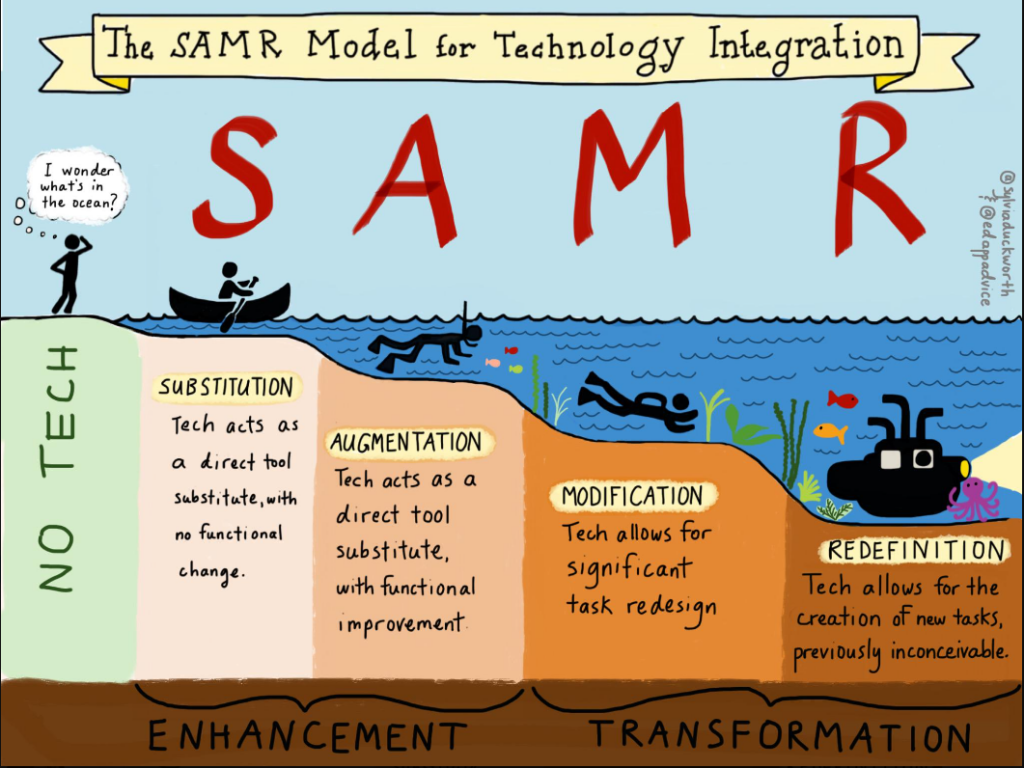
In the video below, Rueben Puentedura, the creator of the SAMR model highlights an example of how this model could be applied moving from the enhancement to transformation stages. In this video, Rueben highlights that in moving from enhancement to transformation, a key change is that activities students normally complete individually become social activities as well. For example, an individual assignment could become a group project. Alternatively, the outcome of a project could be shared with the wider community.
Applying SAMR in the Classroom
Example: Learning About Seismic Waves
When an earthquake occurs, seismic waves are released. There are different types of seismic waves which behave in different ways. These waves can be detected and recorded by an instrument called a seismometer. Learning about different types of seismic waves and their detection is part of the Geology 12 curriculum in B.C.
Substitution: Instead of drawing a diagram of different seismic waves on the board, use a diagram from the internet on a powerpoint slide.
Augmentation: Instead of a diagram, use a simulation to demonstrate the differences in behaviour of different types of seismic waves.
Modification: In groups, ask students to create a short video clip simulating the motion of the different types of seismic waves through dance.
Redefinition: Introduce a seismometer into your school so that students can see how seismic waves are detected and recorded in real-time. In groups, students could analyze some of the data from the seismometer and compare it to the data coming from other school-seismometers in the region. More resources here.
Leave a Reply
You must be logged in to post a comment.